

The pace of technological change has moved past incremental evolution into a state of continuous, fundamental disruption. Across every sector of the global economy, emerging tools are not merely streamlining existing workflows; they are dismantling legacy frameworks and rebuilding industries from the ground up. Technologies such as agentic artificial intelligence, spatial computing, autonomous robotics, digital twins, and advanced cloud architectures have crossed critical thresholds from theoretical promise to operational reality.
In this new paradigm, market leadership is no longer preserved by corporate size or historical legacy. Instead, organizational survival depends on technical adaptability, dynamic decision-making, and the willingness to discard legacy business models. Examining the industries experiencing the most severe structural shifts illustrates how technological disruption is permanently altering the global economic landscape.
The Mechanics of Technological Disruption
Disruption occurs when a new technology fundamentally changes the cost structure, accessibility, or delivery model of a market, making traditional methods obsolete. Historically, technological shifts unfolded over decades, granting incumbent organizations time to absorb new practices. Today, the convergence of high-speed connectivity, cheap scalable compute, and autonomous decision-making algorithms has accelerated this cycle dramatically.
Modern tech disruption is driven by three interconnected catalysts:
-
Autonomous Intelligence: Systems are moving from static analytics dashboards to autonomous software agents capable of evaluating environmental context, planning complex procedures, and executing tasks without continuous human oversight.
-
Physical AI Integration: Artificial intelligence is escaping digital screens and embodying physical hardware, from autonomous warehouse fleets to advanced robotic surgery platforms.
-
Interoperable Data Infrastructure: Value chains are abandoning sequential, manual hand-offs in favor of real-time, continuous data flows that automatically update inventory, pricing, and operational logic.
Healthcare and Medicine: From Reactive Treatment to Autonomous Prevention
Healthcare has long been hampered by administrative overhead, diagnostic bottlenecks, and reactive treatment protocols. Technological disruption is transforming medicine from an episodic service into a continuous, data-driven preventative framework.
Autonomous Diagnostics and Genomics
Artificial intelligence models trained on vast datasets of medical imaging, genomic sequences, and electronic health records are achieving diagnostic precision that rivals or surpasses human specialists. Advanced algorithms can detect subtle cellular anomalies in radiological scans years before physical symptoms manifest. Furthermore, genomic sequencing integrated with machine learning enables the rapid synthesis of personalized therapeutic treatments engineered for an individual specific genetic blueprint.
Physical Robotics and Tele-Surgery
In operating rooms worldwide, robotic surgical platforms guided by real-time spatial mapping allow surgeons to perform complex, minimally invasive procedures with sub-millimeter accuracy. Coupled with ultra-low latency telecommunication networks, specialist surgeons can operate on patients thousands of miles away, effectively eliminating geographical barriers to specialized surgical care.
Banking and Financial Services: The Collapse of Traditional Intermediaries
The financial services sector is experiencing a complete restructuring of how capital is stored, transferred, and managed. Traditional banking institutions, once reliant on physical branch networks and manual underwriting, are being replaced by automated, API-driven ecosystems.
-
Algorithmic Underwriting and Risk Assessment: Machine learning models evaluate creditworthiness in real time by analyzing thousands of dynamic data points beyond traditional credit scores. This allows instant loan approvals, precise interest rate calibration, and vastly reduced default rates.
-
Agentic Financial Management: Autonomous financial software agents now handle treasury operations, portfolio rebalancing, and tax-loss harvesting automatically. These systems monitor global macroeconomic shifts and execute micro-transactions to optimize yields continuously.
-
Decentralized Systems and Real-Time Settlement: Blockchain infrastructure and programmable digital currencies are replacing slow, costly clearinghouse networks. Instant cross-border settlements reduce transaction friction, lower capital requirements, and dismantle legacy banking fee structures.
Supply Chain, Logistics, and Manufacturing: The Dawn of Physical AI
Global supply networks and manufacturing facilities have transitioned from traditional assembly lines into autonomous, software-defined operational environments. Chronic labor shortages, geopolitical friction, and demand volatility have forced industrial sectors to embrace physical automation at scale.
Digital Twins and Simulation-First Engineering
Before physical capital is committed to building a new facility or manufacturing a physical product, organizations create physically accurate digital twins in virtual environments. These virtual replicas allow engineers to run millions of operational simulations, testing stress tolerances, workflow bottlenecks, and energy consumption patterns to optimize performance before physical deployment.
Software-Defined Automation and Autonomous Logistics
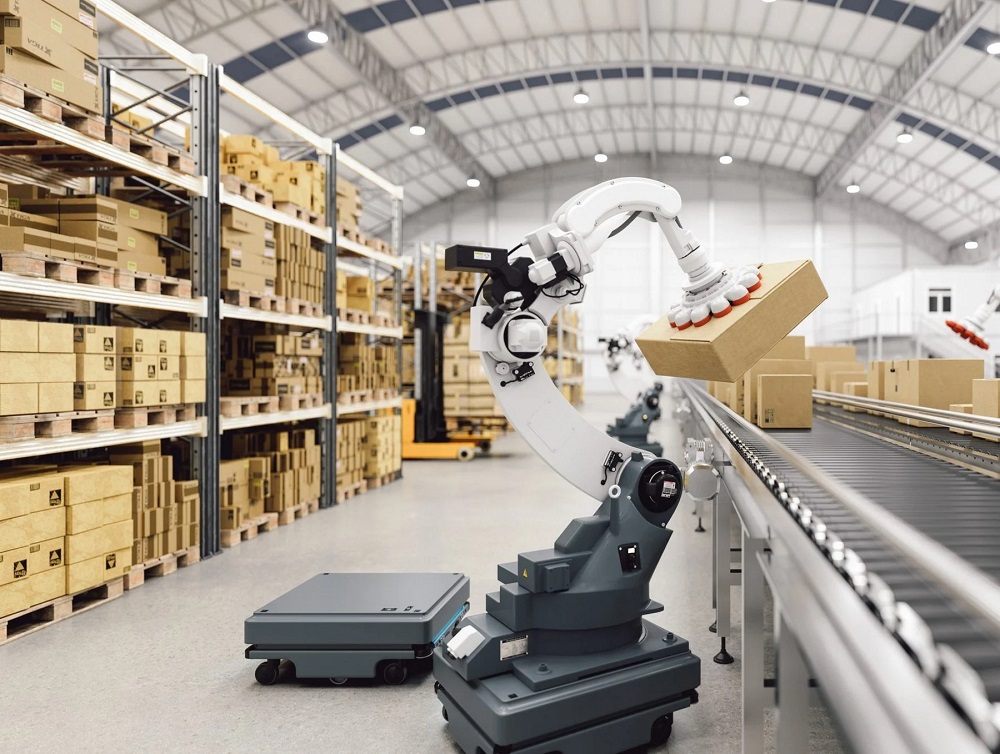
In modern warehouses and smart factories, autonomous mobile robots coordinate inventory distribution through integrated fleet management software. Control logic is no longer tied to rigid physical hardware controllers; instead, it operates as a software layer on generic edge devices, allowing manufacturing setups to reconfigure their assembly procedures dynamically in response to supply changes.
Retail and E-Commerce: Hyper-Personalization and Agentic Commerce
The retail industry has evolved far beyond the basic transition from brick-and-mortar storefronts to standard e-commerce websites. The current wave of tech disruption is reshaping how products are discovered, evaluated, and purchased.
-
Machine-to-Machine B2B and B2C Purchasing: As consumer-facing AI agents mature, buying decisions are increasingly mediated by software. Personal AI assistants analyze user preferences, compare real-time market offers, negotiate terms, and execute purchases automatically without requiring manual scrolling through product catalogs.
-
Predictive Demand Forecasting: Retailers deploy predictive analytics models that anticipate consumer demand patterns down to specific postal codes. Goods are shipped to regional fulfillment hubs before a customer even places an order, enabling rapid fulfillment while minimizing warehousing overhead.
-
Immersive Spatial Commerce: Spatial computing applications allow consumers to interact with digital three-dimensional product representations inside their physical living spaces, eliminating uncertainty around sizing, styling, and spatial fit.
Media, Entertainment, and Content Creation: The Generative Shift
No sector has felt the immediate, disruptive impact of generative software technologies more acutely than media and entertainment. The traditional mechanics of content production, distribution, and monetization have been fundamentally upended.
High-fidelity generative visual tools, automated audio synthesis, and natural language platforms have drastically lowered the capital required to produce studio-grade media. Independent creators can now write, score, render, and distribute film and interactive experiences that previously required millions of dollars and massive technical crews.
Simultaneously, distribution platforms are moving away from broad broadcast channels toward hyper-personalized media streams. Algorithms curate individualized content feeds tailored to real-time user engagement metrics, forcing legacy studios, music labels, and publishing houses to adapt their monetization frameworks or risk total irrelevance.
Strategic Frameworks for Surviving Perpetual Disruption
Navigating an era of continuous technological disruption requires corporate leadership to abandon static, multi-year strategic plans in favor of flexible, adaptive operational frameworks.
Organizations seeking long-term resilience must prioritize three organizational capabilities:
-
Building Modular Architectures: Legacy monolithic IT systems must be replaced with flexible, API-driven cloud architectures that allow new software tools and automated components to be integrated without breaking underlying infrastructure.
-
Embedding Continuous Data Governance: As autonomous software agents assume greater operational responsibility, establishing rigorous data pipelines, security protocols, and human-in-the-loop oversight mechanisms becomes essential to prevent systemic errors.
-
Fostering a Culture of Re-Skilling: Rather than viewing technology as a replacement for human staff, market leaders utilize digital automation to eliminate routine administrative tasks, re-skilling their workforce to focus on strategic reasoning, complex problem solving, and innovation.
The current wave of technological disruption is neither a temporary trend nor a minor operational adjustment. It represents a permanent structural transformation of global commerce. Organizations that proactively align their operations, workforce, and technological infrastructure around these new realities will define the future of their respective industries.
Frequently Asked Questions
What is the primary difference between technological innovation and technological disruption?
Technological innovation involves improving existing products, services, or processes within an established market framework, such as making a smartphone processor faster. Technological disruption fundamentally changes how a market operates, creating new value networks and making legacy business models, skills, and infrastructure obsolete.
How does agentic artificial intelligence differ from traditional software automation?
Traditional software automation follows rigid, pre-programmed rules to execute specific, repetitive tasks. Agentic artificial intelligence evaluates its operational environment independently, plans multi-step procedures, adapts to unexpected obstacles, and executes complex decisions autonomously without requiring step-by-step human prompts.
Why is data governance critical during periods of rapid tech disruption?
As organizations integrate autonomous software agents and predictive analytics into core operational workflows, inaccurate, biased, or insecure data can lead to widespread system failures, legal liabilities, and regulatory penalties. Robust data governance ensures that automated systems operate on secure, audited, and compliant information streams.
How are traditional supply chains adapting to unpredictable disruption events?
Modern supply chain operations are shifting from reactive management to predictive resilience. They utilize IoT sensor networks, digital twin simulations, and predictive AI analytics to detect logistics bottlenecks, tariff shifts, or weather delays in real time, automatically rerouting shipments and reallocating inventory before disruptions impact customer delivery timelines.
Will technological disruption eliminate the need for human workforces in traditional sectors?
Technological disruption shifts the nature of human labor rather than eliminating it entirely. While routine, rules-based, and manual tasks are increasingly automated, demand grows rapidly for human workers skilled in system architecture, AI governance, creative problem solving, strategic management, and complex interpersonal coordination.
What is a digital twin, and how is it used in industrial operations?
A digital twin is a high-fidelity, physically accurate virtual representation of a physical asset, process, or facility. Industrial operators use digital twins to simulate operational scenarios, predict maintenance needs, optimize energy efficiency, and test production changes in a risk-free virtual environment before applying changes to physical infrastructure.
How can legacy businesses compete against digital-native startups?
Legacy businesses can maintain their competitive advantage by leveraging their deep operational domain expertise, existing customer trust, and proprietary historical data while aggressively modernizing their underlying technology stack. By wrapping legacy systems in modern API layers and partnering with agile technology providers, established firms can innovate rapidly at scale.